Building Elsa 4 · Week 23: One Repo and Three Persistence Modes
By Sipke Schoorstra · 2026-10-16

Foundation and Studio move into one repository as Elsa 4 simplifies its execution engine around Durable, Balanced, and Ephemeral persistence.
October 9–15, 2026
Last week we wrote separate source guides for Foundation and Studio. This week we brought the two source trees together. We also changed the default persistence behavior for a workflow run. Both changes came out of a review of the complexity we were asking contributors and Elsa hosts to carry. Simplification decisions, Repository consolidation
One change can now span the server and the editor
Foundation and Studio came together in the Foundation repository under Essentials/, Extensions/, and Studio/. Optional backend capabilities can now live alongside the Studio modules that expose them. The merge preserved Studio's commit history and kept the two products' independent builds and package identities. A change to an activity contract and its editor can now be reviewed from one checkout. Consolidation design and validation
The simplification work also started making internal types private to their implementation by default. The first guard infrastructure made exported APIs an explicit choice, with the rollout proceeding domain by domain. This matters to anyone writing an extension. The package should make it possible to see which interfaces we intend you to build on. Simplification decisions, Public API and domain guards
Pick how often a workflow commits
There are three modes on one drain path. Durable caps a commit at one activity. Balanced, the default, can group activities and commits at the configured cap or a lifecycle boundary. Ephemeral removes the activity cap. If a run reaches the end without needing a prior commit, the host can omit its completion record when RecordCompletion is off. Suspension and the attempt claim before an activity outside the replay-safe profile still require durable boundaries. Persistence modes
We found an edge case almost immediately. When a host died before the first commit, the recovery command could start without enough information to find the workflow's chosen mode. It would then use the host default. The follow-up made the redrive preserve the run's original mode. That's the case worth testing when a setting affects how the evidence of the setting itself is persisted. Redrive fix
Familiar controls in Studio
Classic became the default theme. The designer also gained in-workflow copy, paste, and duplicate. Copying a group preserves its inputs and the connections within the selection. The copies get fresh node IDs, including remapped IDs inside nested containers, and one undo removes the whole paste. The October progress update has screenshots and the wider Elsa 3 context. Classic theme, Designer duplication
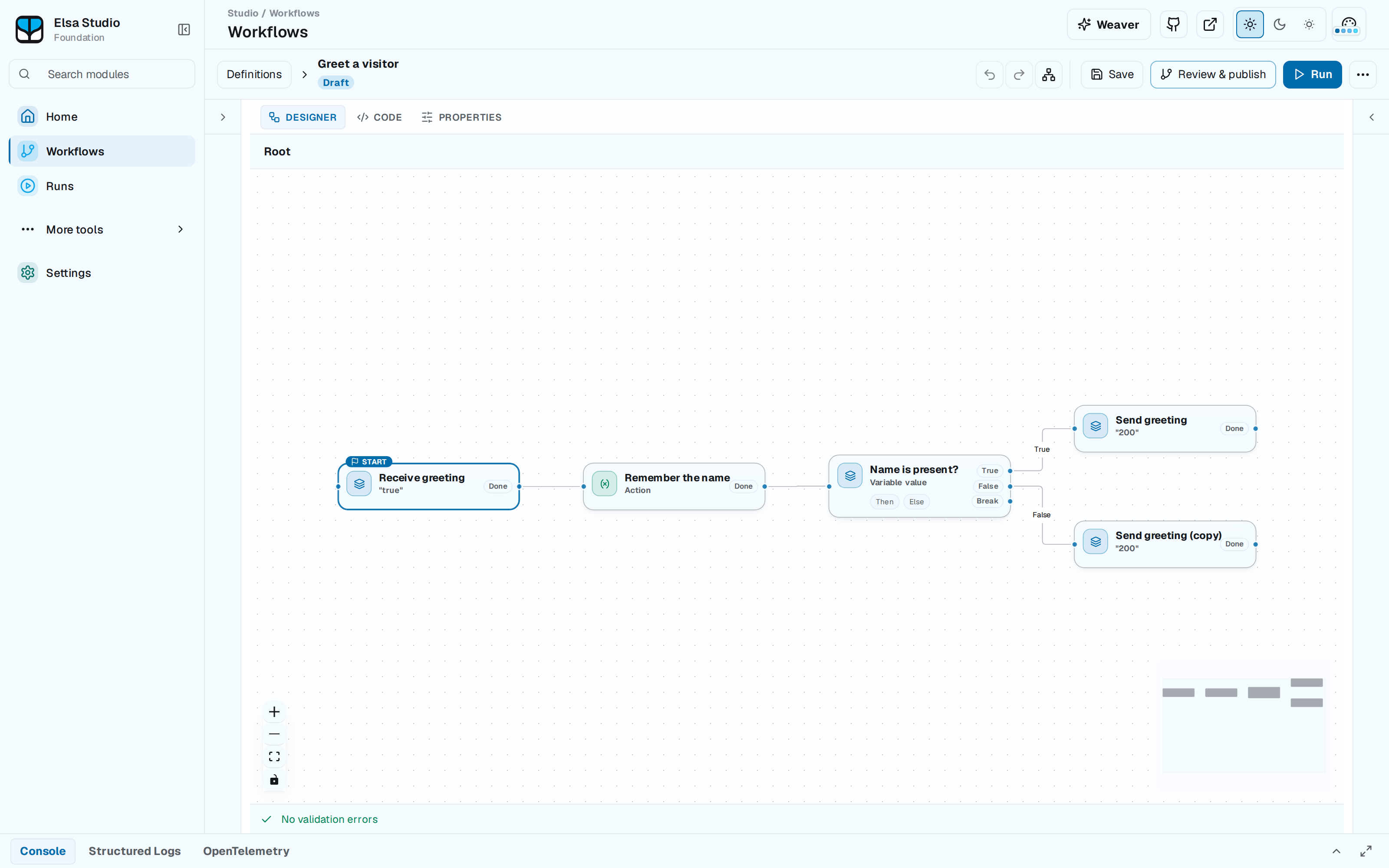
The greeting workflow in the Classic light theme, from the October Studio preview.