Building Elsa 4 · Week 6: Making the Engine Observable
By Sipke Schoorstra · 2026-06-19
Week 6 of Elsa 4: structured logs and OpenTelemetry diagnostics land behind contracts, identity auth arrives, Studio is split into its own repo, and an agent harness appears.
Key Takeaways
- Week 6 (2026-06-12 → 2026-06-19) makes the new runtime observable: structured logs (PR #86) and OpenTelemetry diagnostics (PR #88) are ported in behind contracts.
- Identity auth lands as contracts plus a provider sign-in (PR #85, PR #87), and Studio is extracted to its own repository (PR #76).
- A Studio agent backend harness appears (PR #90) — the quiet groundwork for next week's Weaver assistant.
Where we are on the road
Last week the runtime stopped being a stub: a checkpoint-based execution engine and a provider-neutral persistence foundation landed in a 67-PR burst (week 5 specs 007–070). A real engine that nobody can see into is a liability. Week 6 answers the obvious next question — what is it doing? — and, in passing, reshapes the project's repository layout for the work still coming.
The headline decision: diagnostics ported in behind contracts, not bolted on
The week's center of gravity is diagnostics, delivered as two coordinated slices. Structured logs arrive first — capture, server-sent-event live streaming, and EF Core persistence — ported into the foundation as a unit (PR #86, spec 073 "Diagnostics — Structured Logs (Capture, Live Streaming & Query)"). Then OpenTelemetry diagnostics follow as a separate slice with its own ingestion and live-streaming path (PR #88, spec 074 "Diagnostics — OpenTelemetry (Ingestion, Live Streaming & Query)").
The word that matters in both PR titles is ported — and the architecture decision is that diagnostics enter as modules behind contracts, not as ambient logging sprinkled through the domain. Structured logs and OpenTelemetry are two implementations of the same observability need, kept separate so a consumer can take one, both, or neither.
What this rules out is observability as a cross-cutting leak — the elsa-core pattern where infrastructure concerns embed themselves in the lowest layer and everyone inherits them (worked examples). Here, the engine emits to a diagnostics contract; whether that's persisted to EF Core or exported via OTEL is a module choice at the edge. The work is tracked as an explicit program goal, Diagnostics Observability Readiness (program goal).
Supporting thread: identity and auth get real contracts
Authentication lands in two halves that mirror Elsa 4's whole method: first identity auth contracts (PR #85), then a provider that implements sign-in against them (PR #87). Contract first, implementation behind it.
The Studio side picks up the matching client work in its own repo — an auth system spec and a Studio auth SDK aligned to the backend sign-in endpoints (studio PR #11, studio PR #9). Auth is the kind of capability that, done casually, leaks framework types everywhere; doing it as contracts plus a provider keeps it swappable and keeps the domain ignorant of the mechanism.
Supporting thread: Studio moves into its own repository
This is the week the workspace split happens: the Studio prototype is extracted to a dedicated repository (PR #76), and elsa-foundation-studio lights up with its own history — 36 commits and 13 merged PRs covering a UI system spec, package management, and the auth SDK above (studio PR #8, studio spec 001-ui-system).
The split is an architectural boundary made physical. The engine and the "modular React studio shell hosted by ASP.NET Core" (studio README) now version independently, which is tracked as a Workspace Split Readiness goal (program goal). Two repos, two release cadences, one protocol between them.
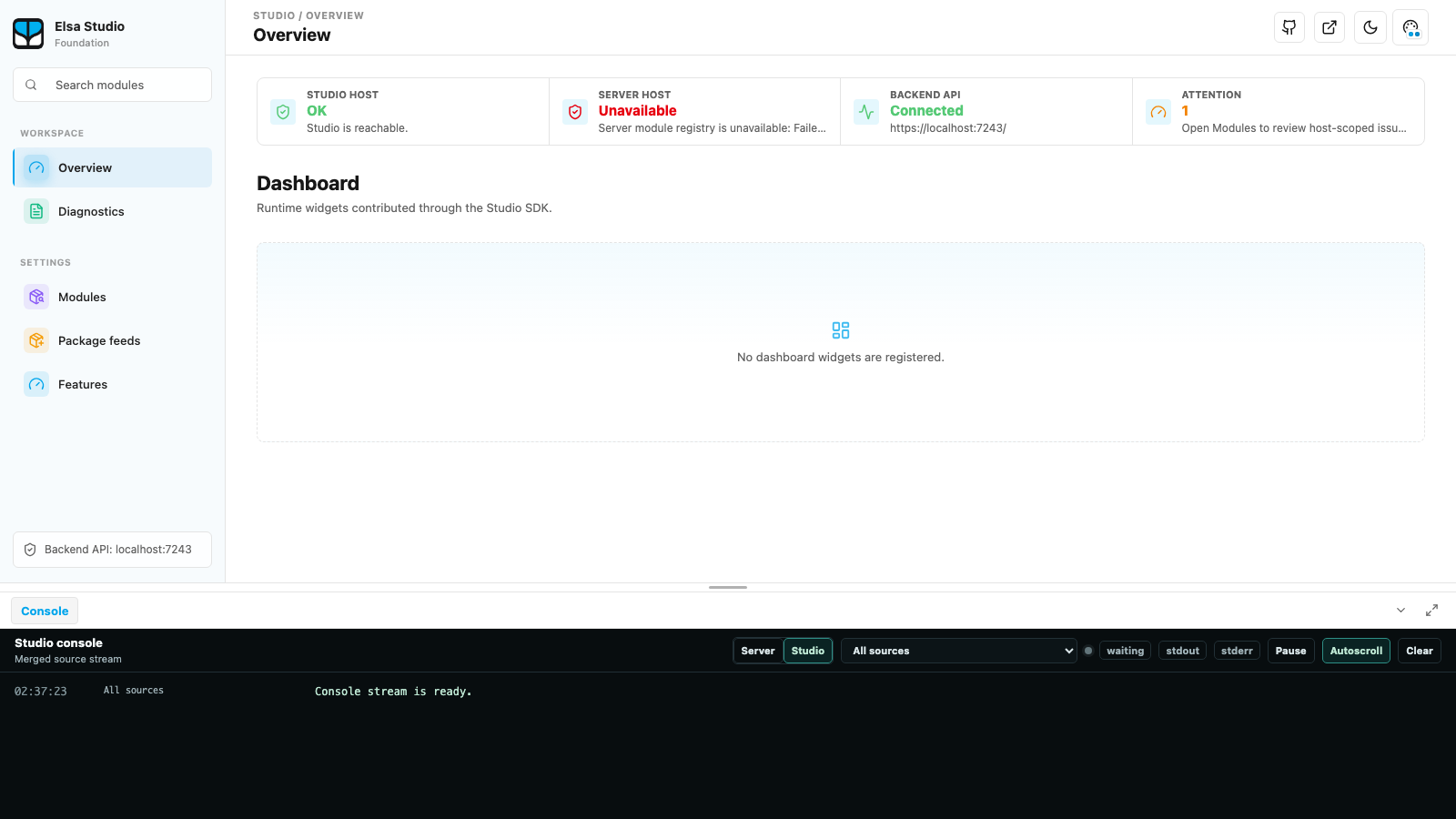
The newly split-out elsa-foundation-studio shell at its Week 6 state (elsa-foundation-studio@e4777f5): the modular React shell hosted by ASP.NET Core, with the merged Studio/Server console stream at the bottom. The navigation is deliberately sparse — Workflows and the Weaver assistant arrive in later weeks. Captured from a local build of the Week 6 commit.
Supporting thread: an agent harness appears
The quietest commit may be the most consequential: a Studio agent backend harness is added (PR #90), with follow-up commits hardening agent resource ownership and proposal execution. On its own it's infrastructure. In context, it's the foundation the Weaver AI authoring assistant is built on next week — and the reason week 7's story is entirely about the trust boundary around that harness. The capability lands here; the safety envelope comes next.
What this unlocks next
Observability plus an agent harness is exactly the runway week 7 uses: with execution finally visible and an agent backend in place, Elsa can give Weaver the power to author workflows directly — and spend most of its effort deciding how to keep that power safe (week 7 trust-boundary ADRs).
This week by the numbers
136 non-merge commits and 16 merged PRs in elsa-foundation, plus 36 commits and 13 merged PRs in elsa-foundation-studio — authored by Sipke Schoorstra across both (foundation history, studio history). If you read only two sources, read the structured logs spec (073) and the Studio extraction PR (#76) — observability and the repo split are the week's two lasting moves.
Follow along
Engine work lives in elsa-foundation; Studio now lives in elsa-foundation-studio. Roadmap context is in docs/program-goals/. Next week: the agent enters the building — behind a trust boundary.